Find a conversation or story that fits your Chinese.
126 published lessons
Conversation podcastsIntermediate · L5
看情况
‘看情况’ — It Depends… But On What? | Chinese Listening
Leo invites Xiao Yue to go hiking, but her answer is only 看情况 — ‘it depends.’ Is that a maybe, a polite no, or a real promise to decide later? In this natural HSK 4–5 conversation, Xiao Yue and Leo unpack the conditions hidden behind 看情况 and show how to be flexible without leaving other people waiting.
Slow monologuesBeginner · L3
坐过站了
I Missed My Stop! 🚌 Slow Chinese Story | 坐过站了
One cute kitten, a few phone messages... and Xiaoyue misses her bus stop! Follow her small adventure in this slow HSK 2-3 Chinese story. Practice asking for directions, checking your bus route, and finding your way back, with Chinese, pinyin and English on screen.
Conversation podcastsIntermediate · L5
差不多
‘差不多’ = Almost, Similar, or Good Enough? | Chinese Listening
Xiao Yue says the cake is 差不多好了 — almost ready. But Leo's friend also said 差不多到了 and kept him waiting for twenty-five minutes. So how close is 差不多, really? In this natural HSK 4–5 conversation, Xiao Yue and Leo unpack four everyday uses of 差不多 and explain when being approximate is helpful—and when it becomes risky.
Slow monologuesBeginner · L3
忘带钥匙了
Locked Out! 🔑 Slow Chinese Story | 忘带钥匙了
What should you do when your keys are inside and you are stuck outside? Follow Xiaoyue through an unexpected lockout in this slow, natural HSK 2-3 Chinese story. Learn how to ask for help, contact a locksmith, and avoid the same mistake next time.
Conversation podcastsIntermediate · L5
没事
‘没事’ Doesn’t Always Mean ‘I’m Fine’ 🤔 | Chinese Listening Practice
Leo arrives twenty minutes late. Xiao Yue says 没事 — ‘it’s fine’ — but then quietly looks down and tidies the table. Is she really fine, politely ending the topic, or hiding how she feels? In this natural Chinese conversation, Xiao Yue and Leo unpack four everyday meanings of 没事 and show how tone, relationships and context change everything.
Slow monologuesBeginner · L3
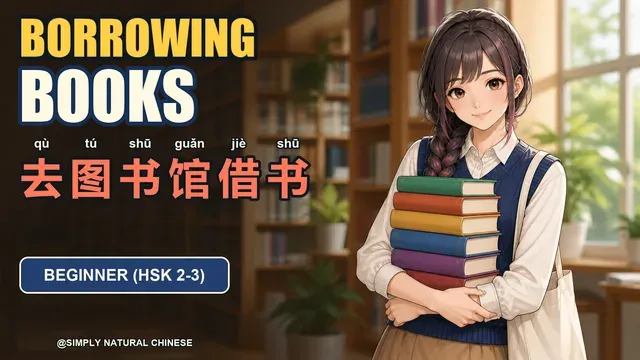
去图书馆借书
Borrowing Books at a Chinese Library 📚 | 去图书馆借书
How do you borrow and return books at a library in China? Follow Xiaoyue on a quiet afternoon trip to her local library in this slow, natural HSK 2-3 Chinese story. She plans to borrow only two books—but somehow leaves with six!
Conversation podcastsIntermediate · L5
来都来了
Why Do Chinese People Say ‘来都来了’? 🤔 | Chinese Listening Practice
You are halfway up a mountain, it starts pouring, and your friend says 来都来了 — ‘we’re already here.’ Is that encouragement, social pressure, or a very Chinese reason to keep going? Xiao Yue and Leo unpack one of the most useful—and occasionally dangerous—phrases in everyday Mandarin.
Slow monologuesBeginner · L3
手机掉在地上以后
After my phone fell on the floor
A dropped phone goes black. Follow Xiaoyue as she handles an order, asks about repairs and protects her photos.
Conversation podcastsIntermediate · L5
你先忙
Does ‘你先忙’ Really Mean You’re Busy? 💬 | Chinese Listening Practice
Someone says 你先忙 — ‘you get back to what you were doing.’ Are they truly being considerate, or politely ending the conversation? Xiao Yue and Leo unpack the small phrases Chinese speakers use to leave a chat naturally, without sounding cold or abrupt.
Conversation podcastsIntermediate · L4
时间观念
He Said He Was On His Way 30 Minutes Ago ⏰ | Chinese Listening Practice | 时间观念
Leo walks in and Xiao Yue reads his own messages back to him. 马上到 at 3:12 — through the door at 3:41. 一会儿给你 on Thursday — delivered Sunday night. 改天请你吃饭 in June — it is now August. He thought all three were times. Not one of them contains a time. China runs on two clocks: the hard one, where trains, flights and clocking in do not wait a minute, and the soft one, where 马上 and 一会儿 are elastic on purpose. Learners get it backwards, too loose where it is hard and too tight where it is soft. This episode is the conversion table.
Slow monologuesBeginner · L3
去药店买药
Sick in China? Go Here First 💊 | 去药店买药 | Simply Natural Chinese
Xiao Yue has a cold, and she does not go to the hospital. She goes downstairs, walks three minutes, and buys what she needs under a glowing green cross. This episode is the one errand every visitor to China ends up running sooner or later: why you can buy most medicine with no prescription at all, and the handful of short sentences that get you helped in thirty seconds. You will also hear the question that surprises everyone at the counter — Chinese medicine or Western medicine? — how to catch a spoken dosage, and the one thing a pharmacy will never do for you. Slow, clear Mandarin the whole way, with Chinese, Pinyin and English subtitles on screen together.
Conversation podcastsIntermediate · L5
称呼
Why You Never Know What to Call People in Chinese 🙋 | Chinese Listening Practice | 称呼
Xiao Yue bets Leo a month of free cake that he cannot correctly address the four people who walked into her shop this morning. He gets three wrong in ninety seconds — including 小姐 (xiǎo jiě), which in much of mainland China is an insult. English hands you a master key: Mister, Miss, or nothing at all. Chinese has none, so the word you reach for has already decided how close you are and who stands above whom before your sentence even begins. This episode is the map: the three words that cover half of daily life, the surname-plus-title rule, the street list, the two words never to say alone, the five relative terms, and the one question that is never rude.